
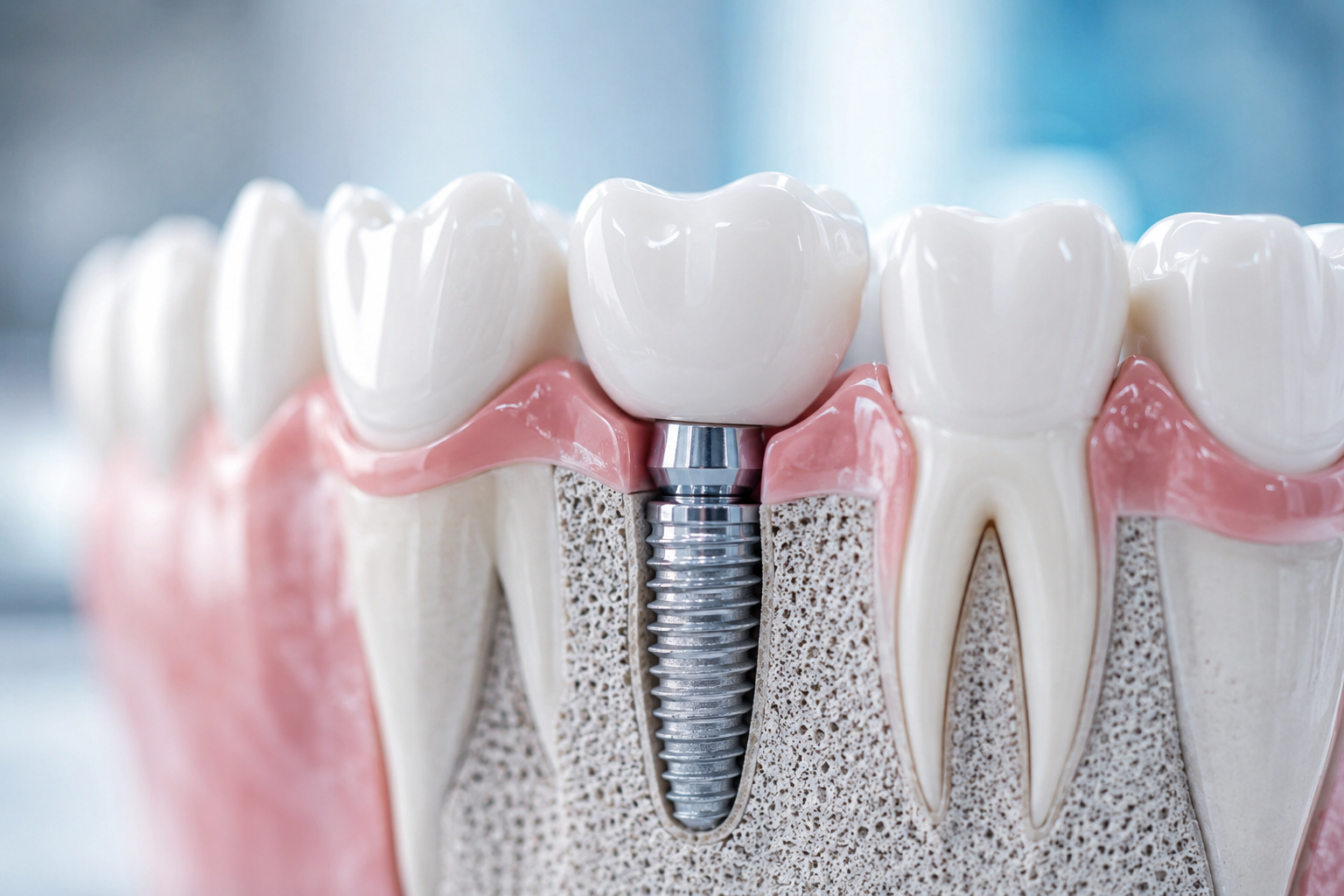
Dental implants can be defined as artificial tooth roots placed into the jawbone. Today, they are generally made of titanium and manufactured in a screw-shaped form.
Single Tooth Loss: The treatment of a single missing tooth without interfering with the adjacent teeth is only possible with an implant. The implant is placed in the position of the missing tooth root, and a porcelain crown is placed on top to restore the function of a complete tooth.
Multiple Tooth Loss and Complete Edentulism: In the treatment of multiple missing teeth, implant-supported bridges can be used to provide fixed restorations without damaging the natural teeth. In cases of complete edentulism, stable removable dentures or fixed teeth can also be provided with implant support.
Tooth Extraction and Same-Day Implant Placement
Placing an implant during the same session as tooth extraction shortens the treatment period, reduces the number of surgical procedures, and can provide a more comfortable healing process. The extraction socket and the implant heal together. With modern dental practices, the indications for immediate implant placement after extraction have increased. However, this procedure is still not suitable in every case.
Following tooth extraction and implant placement, a temporary tooth may also be placed on the implant during the same session.
Fixed Teeth in One Day
In cases of tooth loss in the aesthetic region, a tooth can be placed immediately on the implant, including situations where the implant is inserted at the same time as the tooth extraction.
For individuals using complete removable dentures, when implants are placed, the dentures can be converted into implant-supported fixed teeth on the same day. It is now possible to transition from removable teeth to fixed teeth in a single day.
Teeth placed on the same day are planned so that they do not receive excessive force until the implant has healed. Sufficient healing time must be allowed after implant placement before the permanent teeth are made.
Flapless Implant Surgery

Computer-assisted implant planning performed before surgery
Using advanced imaging techniques, implants can be placed with flapless surgery through a guide prepared in advance. With this advanced technology, the entire procedure is planned beforehand on a computer; the tissues are evaluated from every angle, the most suitable areas for implant placement are determined, and the diameter and length of the implants to be used are selected accordingly. A surgical guide is then prepared based on this planning. During surgery, only the guide is positioned in the mouth, and the implants are placed through the pre-designed openings in the guide.
All-on-4
All on 4, is an implant procedure for edentulous jaws in which a fixed temporary prosthesis can be placed immediately on four implants, followed by a permanent full-arch fixed prosthesis after the healing period. In this procedure, two of the implants are placed at an angle. This makes it possible to extend the restoration toward the posterior region in cases where there is insufficient bone in the back of the jaw and also allows an immediate fixed temporary prosthesis to be provided. The temporary teeth are primarily intended to provide social comfort during the healing period. Since excessive chewing forces should not be applied to the implants at this stage, the temporary prosthesis is not extended too far toward the posterior region. When the permanent prosthesis is made on four implants, the number of teeth is also generally lower than the natural dentition of a young adult. The rearmost large molar teeth are usually not included in the permanent prosthesis.

Production stages of a one-piece implant-supported fixed prosthesis (Toronto bridge)
All-on-5
Al on 5, is an implant procedure for edentulous jaws in which a one-piece fixed prosthesis for an entire arch is supported by five implants. In this procedure, two implants are placed at an angle, making it possible to extend the restoration toward the posterior region when there is insufficient bone at the back of the jaw. It also allows an immediate fixed temporary prosthesis to be provided. The temporary teeth are designed to provide social comfort without placing significant chewing forces on the implants. Therefore, the temporary prosthesis is not extended too far toward the posterior region. Once healing is complete and the permanent fixed prosthesis is made, greater chewing forces can be supported. However, the rearmost molars may still be excluded. Five implants can support a sufficient number of teeth to provide effective and comfortable chewing.
All-on-6
All on 6 is an implant procedure for edentulous jaws in which a one-piece fixed prosthesis for an entire arch is supported by six implants. In this procedure, two implants may be placed at an angle, allowing the restoration to extend toward the posterior region when there is insufficient bone at the back of the jaw. It also makes it possible to provide an immediate fixed temporary prosthesis. The temporary teeth are not extended toward the posterior region, helping to protect the implants from excessive chewing forces during the healing period. After healing, six implants can support a sufficient number of teeth to provide effective and comfortable chewing.